

Initial Concept
I made up my mind early on that the first original circuit I would design would be an overdrive pedal. First, it’s a relatively easy place to start. Second, almost every pedal company has a go-to signature overdrive, some have several, and it’s typically one of their best sellers. Third, I was never fully happy with any of the overdrives I owned over the years, although there are plenty of good ones.
Another major consideration was making something for my local scene. I wanted to build a pedal that would be useful to the people closest to me first, and then let it spread from there. The goal was an overdrive that could handle heavy riffs, harmonic rich textures, and pushed cleans equally. Something that feels at home whether you’re leaning into heavy, riff-driven playing or laying back into spacious, melodic lines.
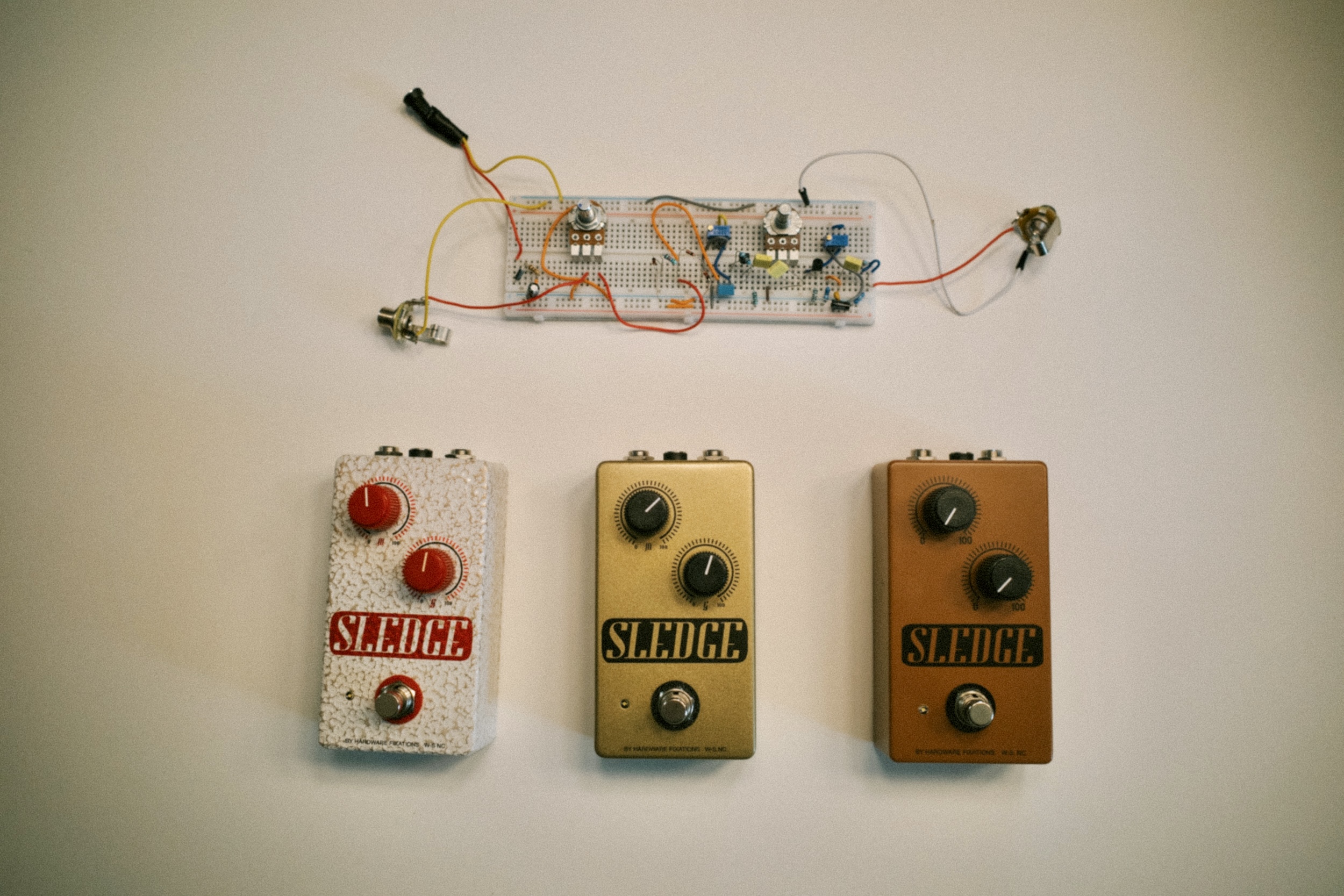
Enter SLEDGE. Honestly, I had this name in my head for an overdrive long before I had a circuit. After all, what does a good overdrive do if not slam your signal into your amp like a big-ass hammer? That idea became one of my main starting points. As a blue collar guy who grew up in a blue collar household I’ve always liked the symbolism of the hammer as a universal tool used in the construction and destruction of almost everything.
From the beginning, I had a clear set of goals. I wanted more gain than typical “transparent” overdrives but retain the ability to clean up when needed. I wanted a mid-forward, guitar-friendly voice. I wanted it to work well with all varieties of amps, guitars, and tunings, and I wanted just a small sprinkle of chaos at the highest gain setting.

Circuit Design
Now for the nerd shit. I’ve built a lot of overdrive clones, and there were a few that really stood out to me. Obviously, the Boss BD-2 (and its various modded cousins), the Barbershop by Fairfield Circuitry, the (borderline-fuzz) Interstellar Overdriver by Death By Audio, and beyond that, the Boss OD series and the Lightspeed by Greer.
There were things I liked about all of these pedals, and some things I didn’t. The circuit topology started out as a mishmash of ideas pulled from several of them and, over the course of a few months, slowly became its own thing.
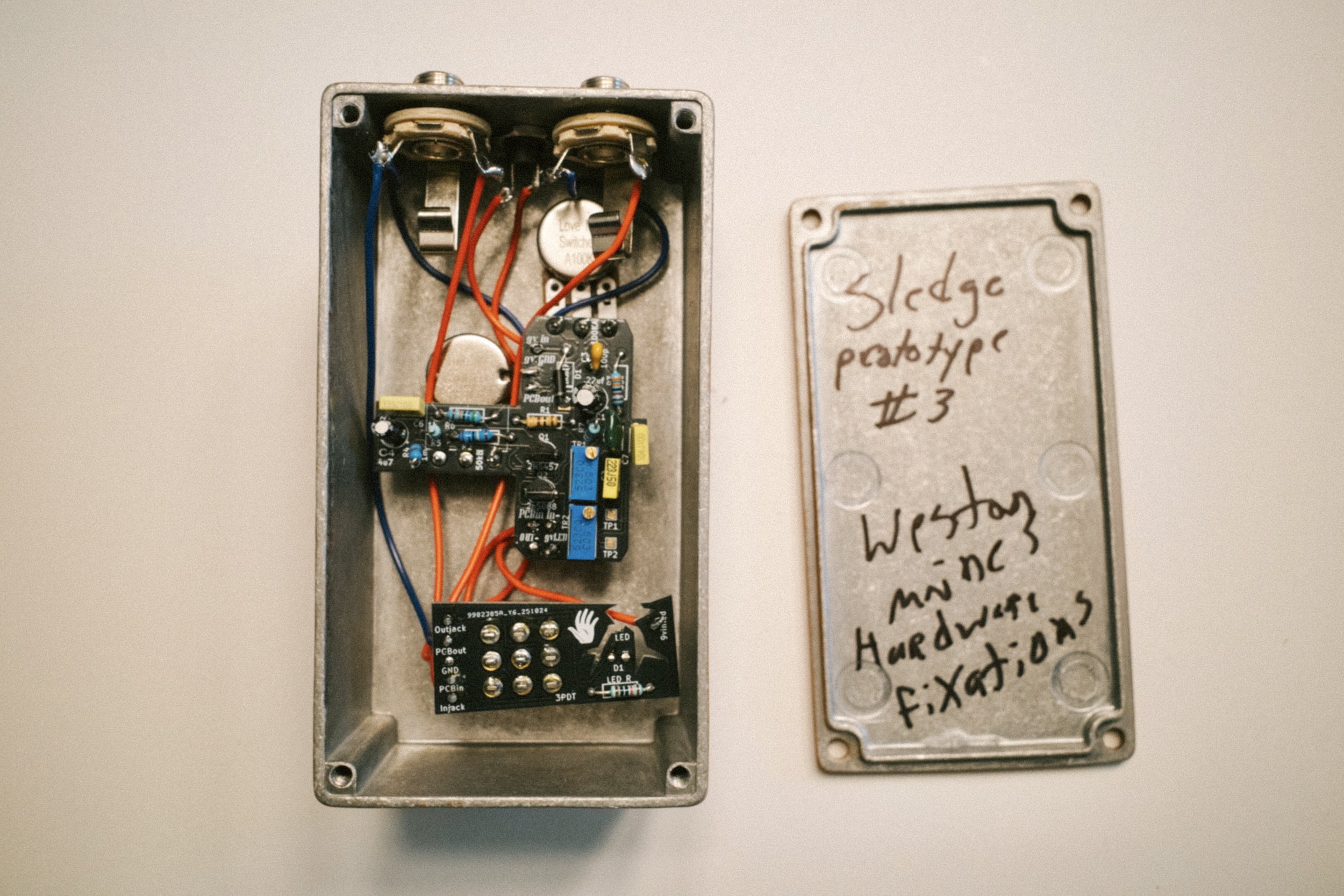
A lot of time was spent experimenting with where the gain lived in the circuit. I experimented with getting more gain up front, other times moving most of it to the later gain stage. This circuit does get some gain/overdrive coming from the first transistor stage compared to it being more of a buffer in some other circuits. It also has trimmers to set the bias on each transistor which helps account for the variability in components.
Shaping the eq to fit with many guitars, amps, and playing styles was no easy task. I spent many hours subbing different capacitor values in and out. I would find something that worked then I would change guitars or amps and then tweak it again. Rinse and repeat that process a few hundred times. Then I did A/B test with other overdrive pedals I liked and tweaked it further. Finally it landed on an eq I liked across the spectrum of all my guitars and amps.
One of the biggest hurdles was uneven sustain, something the BD-2 famously suffers from, especially at lower gain settings. I tried output buffers and a wide range of clipping approaches before finally settling on asymmetric clipping with Zener diodes. Clipping is something that could be tweaked endlessly and has a huge effect on the final sound. The clipping stage I ended up with allowed the signal to stay open and dynamic without getting squeezed too early or too tightly. It also made the sustain even throughout all the gain levels.
It took a lot of work and an unhealthy number of late nights with a breadboard and a wide variety of parts but I think I accomplished what I set out to do.
The gain works equally well with single coils or humbuckers, into clean or dirty amps. With single coils, you can go from transparent enhancement all the way up to medium-gain overdrive. With humbuckers, you can start at edge-of-breakup and push into borderline distortion territory. With great clean up on the volume knob throughout the gain range.
It doesn’t have a tone knob, and I know for some people that might be a deal breaker. But I’ve found that with most overdrives, players discover one setting they like and leave it there. The stock voice is the one I found most desirable. I played many different guitars tuned differently with different pickups into many different amps. I tweaked and tweaked finding the middle ground that sounded like the best fit for the herd. I intentionally set the EQ to lean very slightly bright, so you can always roll back your guitar’s tone control to taste if desired. If it were fixed too dark, there would be no way to correct that. That mid-focused brightness is also part of the charm. It helps SLEDGE survive walls of reverb and delay and cut through a band mix.
Pedal design
For the look of this pedal I didn’t want to go attention grabbing meme pedal or over the top edge lord. I wanted to make something that felt classic, minimalistic, slightly villainous, and something that feels in some ways old and new at the same time.
If I had to pitch this pedal in a few simple words I would say it has an incredibly wide range of gain tones, clean sustain throughout, and a voice that shines with many different guitars, amps, and playing styles.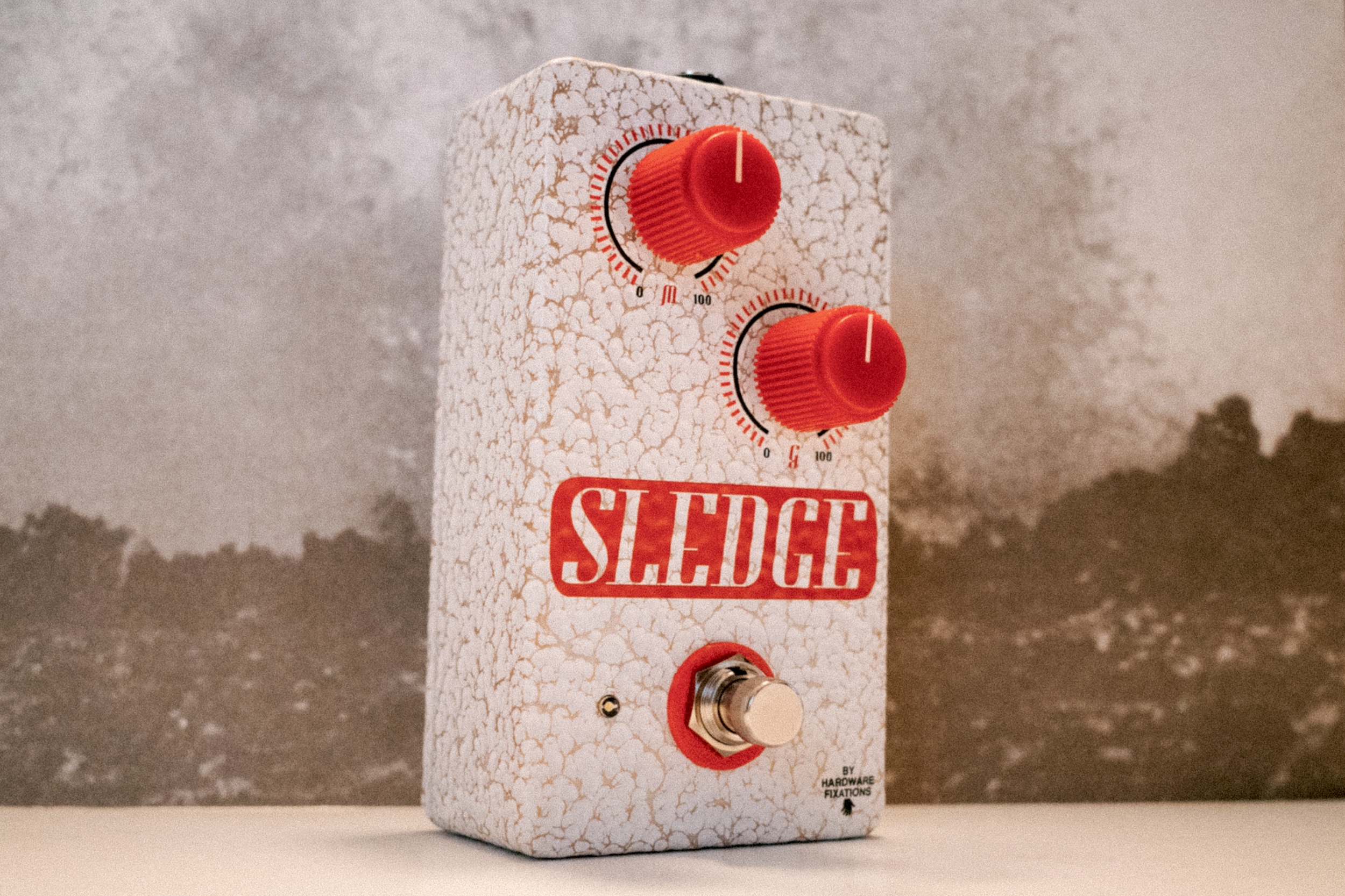
SLEDGE will release on Tuesday March 17th. Please check out a demo or catch me in person at an upcoming event to try one out!